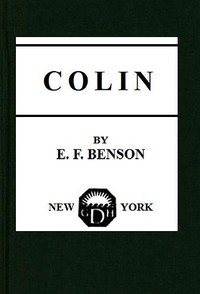
Colin — A Closer Reading
Edition facts
The Staniers treat their Elizabethan family legend with 'cynical complacency,' a detail that immediately signals the blend of superstition and worldly pragmatism running through E. F. Benson's prose. The legend itself is introduced through a vivid set piece: Queen Elizabeth, visiting Rye, is saved from a fall by young Colin Stanier, whose 'blue eyes as the sea' and 'tumble of his yellow hair' captivate her. Benson's diction here is deliberately heightened—'zounds,' 'gadzooks'—matching the romantic origin story.
Yet the narrative voice undercuts this fairy-tale opening with a dry, modern irony. The family, we are told, 'would have denied that, either drunk or sober, they believed it,' yet find it 'vaguely pleasant' to have a guarantee of worldly success. This tension between credulity and cynicism shapes the authorial choices throughout the excerpts.
The Gaze as a Weapon
Benson repeatedly invests Colin's eyes with almost supernatural force. In the opening legend, the Queen notes 'something both gay and bold' in his look. Later, during a tense negotiation with Uncle Salvatore, Colin's 'blue gay glance' is described as 'luminous,' as if 'a smouldering light actually burned behind them.' Salvatore, 'superstitious, like most Southern Italians,' makes the sign of the cross under the table, sensing 'the evil eye.'
The authorial choice is precise: Colin's gaze is not merely attractive but coercive. He tells Salvatore, 'My friends lead more enjoyable lives than my enemies,' and the threat is delivered with a smile. Benson uses physical description to externalize psychological dominance, making the eyes a recurring motif of power.
Dialogue as Coercion and Performance
Colin's speech in the negotiation scene is a masterclass in veiled threat. He structures the exchange as a series of rhetorical questions: 'You might tell me, I fancy, straight off, whether you accept or reject my proposal.' The conditional 'I fancy' and the adverb 'straight off' create a veneer of politeness over an ultimatum. He reminds Salvatore of financial leverage and dismisses the possibility of blackmail with ironic praise of 'gentlemanly feelings.'
Benson's dialogue reveals character through rhythm and subtext. Colin's sentences are clipped, logical, and escalating in pressure. Salvatore's responses are minimal, internal. The author does not need to state who holds power; the cadence of the conversation makes it evident.
The Unseen Twin and the Shadowy Household
Though the excerpts focus on Colin, the narrative hints at a twin brother, Raymond, whose engagement to Violet is described through the father's uneasy perspective. Violet 'seemed indeed to tolerate, rather than adore her lover,' and Raymond's devotion is 'dog-like in fidelity.' Benson uses animal imagery—'dog-like'—to contrast with Colin's predatory feline confidence.
The household during Colin's absence is populated by near-ghosts: Lady Hester has gone to town, Ronald and his wife are at Marienbad, and old Lady Yardley 'hardly ever spoke' and 'remained invisible till the approach of the next dinner-hour.' Benson's description of her as 'whitely impassive' and the 'mist that was thickening about her mind' suggests a domestic atmosphere of decay and waiting, a counterpoint to Colin's dynamic presence.
Structure and the Unfinished Romance
The author's prefatory note states that Colin 'comprises the first part only of this romance; it will be completed in a second volume which will tell of the final fading of the Legend.' This structural choice is unusual: the book is explicitly a fragment, and the narrative arc is deferred. Benson signals that the legend's power will wane, not climax, in the sequel.
The excerpts show a story built on anticipation—Colin's arrival, the resolution of the bargain, the triangle with Raymond and Violet. Yet the prose lingers on atmosphere and psychological detail rather than plot advancement. The reader is positioned like the waiting household, sensing that the real action will begin when Colin returns.
Benson's authorial choices in diction, dialogue, and description create a world where charm is a form of coercion and family legends are both mocked and wielded. Readers attentive to the precise weight of a glance or the rhythm of a threat will find the novel's texture rewarding. The incomplete status of the romance invites speculation about how the legend will fade, but the excerpts offer no clues to that resolution.