
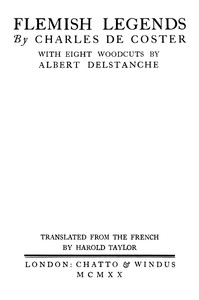
Flemish Legends — Background and Themes
Edition facts
In Flemish Legends, Charles de Coster retells four folk tales from Brabant and Flanders, first published in the 1850s. The excerpts show a world where the supernatural intrudes directly into moral reckonings: a heart of stone is trampled and cursed to suffer for a thousand years, a head sings a faery song before delivering a death-cry, and a child’s prayer is dismissed by a vengeful stone prince. De Coster’s prose is stark and rhythmic, often repeating phrases like “Ambitious heart, heart of stone, suffer and bleed, my cousin” to hammer home his themes. The translator, Harold Taylor, notes that de Coster was a poor, independent-minded writer who drew on local folklore while infusing it with a democratic, anti-authoritarian spirit.
The Weight of Stone: Justice and Transformation
The excerpt from “Sir Halewyn” centers on a punishment that is both literal and symbolic: the miserly lord’s heart is turned to stone, then cursed to endure a thousand years of suffering as a hearth-stone, paving-stone, or church stone. De Coster’s language is precise and repetitive, emphasizing the physicality of the transformation. The Prince of the Stones, a mannikin figure, speaks in a voice that “hissed like a viper and scraped like a thousand pebbles,” grounding the supernatural in tactile, auditory detail. The curse explicitly links the lord’s crimes—starving the poor, bringing cold into their homes—to his eternal punishment. This is not a vague moral lesson but a specific, almost legalistic retribution, where the stone heart becomes a permanent record of his sins.
Voices of the Dead: Song and Silence
Throughout the excerpt, sound plays a crucial role. The head sings a “faery song” sixteen times, each followed by a death-cry, as the virgins are freed from a spell. The child’s prayer is described as “in this wise,” with direct, simple words: “Dear Lord, see how much he is suffering!” Yet the mannikin rejects it harshly, calling her a “little ragamuffin.” De Coster contrasts the melodic, freeing song with the rasping, scraping voice of the stone prince, and the silent departure of the virgins “walking silently over the snow like a living person.” This interplay of sound and silence reinforces the boundary between the human and the supernatural, the merciful and the implacable.
Folkloric Roots and Literary Craft
The translator’s note reveals that de Coster gathered these tales from “the folk-lore of Brabant and Flanders,” but the excerpts show he reshaped them with a distinctive voice. The repeated phrase “Ambitious heart, heart of stone” echoes a ballad-like refrain, while the detailed description of the heart being “thrown down into the snow” and “trampled” adds a visceral immediacy. De Coster’s background—he preferred the popular University of Brussels to the aristocratic Louvain, and was part of a society called Les Joyeux—suggests a deliberate alignment with folk culture against elite institutions. The legends are not merely transcribed but crafted, with a clear moral and political edge that targets greed and cruelty.
Readers should approach Flemish Legends as a literary reimagining rather than a direct transcription of oral tales. De Coster’s democratic sympathies and his use of repetitive, incantatory language give these stories a distinctive texture. The excerpts suggest that each legend operates as a kind of moral fable, where supernatural events serve to expose and punish social injustices. Pay attention to the sensory details—the sound of a voice, the feel of snow, the weight of a stone—as they carry much of the meaning.