
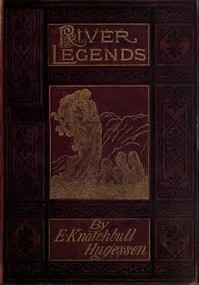
River Legends; Or, Father Thames and Father Rhine — Inside the Classic
Edition facts
The volume opens with a framing device: Father Thames and Father Rhine meet and exchange stories, each river personified as a garrulous old man. Thames drinks ale and grows boastful; Rhine, more dignified, summons elves and spirits to illustrate his tales. This conversational frame sets the tone for a collection that moves freely between English and German legend, often with a wry, humorous narrator who addresses the reader directly. The nine tales that follow include boar hunts, family feuds, vengeful maidens, giants, and sea-serpents, all illustrated by Gustave Doré. The narrative voice is chatty and digressive, fond of asides about human nature and the folly of its characters.
A Frame of Two Rivers
The book’s structure is unusual: it begins not with a story but with a conversation between two river gods. Father Thames, described as “a jolly old fellow,” drinks ale and tells a tale of a great boar in Windsor Forest. Father Rhine, more solemn, responds with a story of elves and a river-demon. This framing device recurs only briefly at the end, where Rhine retreats into his waters. The effect is to present the legends as oral performances, each river god vying for the listener’s attention. The narrator often breaks in with comments like “I am not quite sure” or “as the story goes,” reminding the reader that these are told, not written, accounts. The rivers themselves become characters: Thames is associated with English countryside and hearty humor, Rhine with German forests and darker magic.
Recurring Images: Boars, Forests, and Water
Certain images recur across the tales. The boar appears not only in the first story but also as a symbol of wildness and danger; in “The Great Boar of Windsor Forest,” the animal is described with “glaring eyes” and “bristling hide.” Forests are the setting for most tales, often described as “deep” and “gloomy,” with paths that lead to unexpected encounters. Water—rivers, streams, or the sea—appears in nearly every story, whether as a boundary, a source of magic, or a threat. In “The Mannikins’ Castle,” a sea-serpent emerges from the waves; in “Martha’s Vengeance,” a river-demon steals a child. The illustrations by Doré emphasize these elements: dark trees, churning water, and monstrous creatures dominate the plates.
Movement Between Scenes
The tales shift rapidly between settings, often without transition. In “The Family Feud,” the narrative moves from a castle interior to a battlefield to a forest glade within a few paragraphs. The narrator uses phrases like “meanwhile” and “it chanced that” to glide between locations. This technique gives the stories a breathless quality, as if the reader is being hurried from one event to the next. In “Sir Roderick Fowle,” the action jumps from a baron’s hall to a Yorkist camp to a lady’s bower, each scene sketched with a few details. The effect is cinematic, though the prose itself is dense with description. Doré’s full-page illustrations often capture a single dramatic moment—a giant weeping, a witch flying—that anchors the shifting scenes.
The Narrator’s Voice and Its Effects
The narrator frequently addresses the reader with asides like “the reader will perhaps be surprised” or “it is not for me to decide.” This creates a conspiratorial tone, as if the storyteller is sharing secrets. The narrator also moralizes, but lightly: after a character’s death, he remarks “such is the end of those who trust in wickedness.” Yet the moralizing is undercut by the sheer absurdity of many events—a giant who cries, a boar that speaks, a witch who flies on a broomstick. The narrator seems aware of this, sometimes adding “if you can believe it” or “so the legend says.” This self-awareness prevents the tales from becoming preachy and keeps them playful. The voice is consistent across all nine stories, unifying the collection despite its varied sources.
Readers approaching River Legends should expect a leisurely, digressive experience. The tales reward attention to detail—the recurring motifs of water and forest, the narrator’s wry comments, the sudden shifts in scene. Gustave Doré’s illustrations, with their dramatic contrasts of light and shadow, complement the text’s blend of humor and horror. The book is best read not as a single narrative but as a series of performances, each story a new voice from the rivers’ banks.