Robin Hood — Context and Discussion
Edition facts
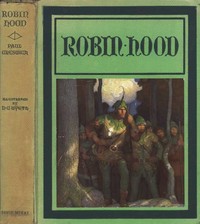
Paul Creswick's 1917 retelling of the Robin Hood legend, illustrated by N. C. Wyeth, opens not in the greenwood but in the domestic sphere of Master Hugh Fitzooth, King's Ranger of Locksley. The narrative immediately establishes a tension between Robin's youthful arrow-making and his father's discontent, a pattern of generational and social friction that will propel the story. The text moves briskly from household to forest to Nottingham, with each shift in setting marked by changes in tone and pace. Wyeth's eight full-page illustrations punctuate key moments—Robin wrestling Will Stuteley, meeting Maid Marian, and his final arrow—anchoring the reader in specific visual tableaux.
Episodic Structure and the Journey Motif
The narrative unfolds in a series of loosely connected episodes, each centered on a journey or encounter. Robin's movements—from Locksley to Gamewell, from the forest to Nottingham—drive the plot forward. The text repeatedly uses phrases like "they walked together" or "he hurried towards the highroad" to signal transitions. These journeys often lead to a test of skill or a disguise: Robin poses as a beggar, a butcher, or a stranger to gather information or aid his companions. The episodic structure mirrors the oral tradition of ballads, where each adventure is a self-contained tale. Creswick links these episodes through recurring characters and the gradual consolidation of Robin's band, but the overall arc remains a series of discrete exploits rather than a tightly woven novel.
Recurring Images: Arrows, Disguise, and the Greenwood
Three images recur throughout the excerpts: arrows, disguise, and the greenwood itself. Arrows appear not only as weapons but as tokens of identity—Robin leaves his peacocked shaft in a slain buck as a signature. Disguise is a constant strategy: Robin trades clothes with a butcher, adopts a staff to enter Nottingham, and conceals his name from young Gilbert. The greenwood is both refuge and stage, described as a place where "the trees nigh shut out the sky" and where the outlaws hold council in caves. These images reinforce the theme of hidden identity and the tension between the wild forest and the ordered town. The illustrations by Wyeth capture these contrasts, particularly in the plate showing Robin and his mother approaching Nottingham Fair, where the road winds through dense trees.
Movement Between Forest and Town
The narrative oscillates between the greenwood and the town of Nottingham, each space carrying distinct connotations. The forest is a place of freedom, camaraderie, and skill—Robin's band gathers in caves, shares meals, and plans their next move. Nottingham, by contrast, is associated with authority, danger, and disguise: the Sheriff's house, the market, and the Bishop's sickbed. Characters cross these boundaries frequently, often with tension. Robin's decision to "disguise himself and go into Nottingham" is a recurring plot device, and the journey itself is described with urgency—"he doubled and trebled his pace." This movement creates a rhythm of concealment and revelation, as the outlaws must navigate between their hidden life and the public world that seeks to capture them.
Voice and Dialogue: The Outlaws' Banter
The dialogue in the excerpts is brisk and colloquial, often laced with humor and quick repartee. When Robin offers to buy a butcher's cart, the butcher replies, "Why, truly, beggar, a bigger price than you will pay, I fear." The outlaws' speech is marked by a democratic tone—they address each other as "friends" and debate plans openly. Young Gilbert's chatter provides a contrast, full of news and naivety. Creswick uses dialogue to establish character quickly: the Ranger's discontent, Dame Fitzooth's spirit, and Robin's persuasive calm. The banter also serves to lighten tense moments, as when the outlaws joke about the price on their heads. This voice, rooted in the oral tradition, gives the narrative a lively, performative quality that complements the episodic structure.
Readers attentive to the interplay of text and illustration will notice how Wyeth's plates often freeze moments of physical action—wrestling, archery, a chase—while Creswick's prose lingers on the journey to and from those moments. The episodic structure rewards dipping in and out, but the recurring motifs of disguise and movement reward a continuous reading. Approach this edition as a series of linked adventures rather than a single arc, and note how each episode builds the legend without resolving it.