Tales and Legends of the English Lakes — Text and Context
Edition facts
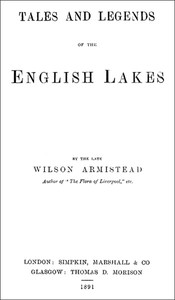
Wilson Armistead's preface to Tales and Legends of the English Lakes frames the Lake District as 'romantic classic ground,' invoking Gray and the Lake Poets before a single legend is told. The catalog subjects—Legends, Tales, Folklore—suggest a straightforward collection of oral tradition, but the excerpts reveal a work more concerned with picturesque scenery and literary allusion than with documenting vernacular stories. The giant narrative that follows is told with novelistic detail and a wry, self-aware narrator who notes that 'the ghosts of murderers, as well as of murderees, if they be right orthodox apparitions, always appear to be re-enacting the closing scene.' This editorial note examines how the book's romantic framing shapes its presentation of folklore.
Scenery Before Story
The preface devotes over 400 words to landscape description before mentioning any tale. Armistead catalogs 'the richest valleys, the wildest mountains, the dreariest moorlands' in a breathless list that reads more like a tourist brochure than a folklore collection. He quotes Sir Walter Scott's 'Lives there a man with soul so dead' to claim the region as 'my own, my native land'—though Armistead was from Liverpool, not Cumbria. This romantic posture suggests the book's primary audience was not local storytellers but middle-class readers seeking an armchair tour of a literary landscape.
The Giant as Literary Construct
The excerpted tale of 'The Giant of the Tarns' is told with elaborate novelistic conventions: dialogue tags ('calling loudly upon him to stay his flight'), dramatic pacing ('the water, pent in by the narrow arch, acquired four-fold force'), and a narrator who comments on his own source ('as my informant naively averred'). The giant is dispatched with 'the blood running like a little brook'—a simile that undercuts any claim to authentic oral tradition. The catalog subject 'Folklore' implies communal belief, but Armistead's treatment is literary, not ethnographic. He does not name his informant or describe the tale's provenance.
Haunting as Narrative Necessity
After the giant's death, the narrator asserts that 'the localities where they occurred must, of necessity, be haunted.' This is not a belief reported from local tradition but a logical deduction from the genre: ghosts appear because the story requires them. The phrasing 'if they be right orthodox apparitions' distances the author from any supernatural claim. The catalog subject 'Legends' suggests a genre of belief, but Armistead treats haunting as a literary convention. Readers expecting authentic folklore will find instead a Victorian antiquarian's self-conscious performance of storytelling, where the landscape is the real subject and the legends are decorative.
Armistead's book is best approached as a romantic travelogue with embedded tales, not as a record of living tradition. The catalog subjects—Legends, Tales, Folklore—are accurate but misleading: the work is more about the Lake District's literary reputation than its oral culture. Readers interested in the Victorian construction of 'folk' material will find rich material here; those seeking unmediated local stories should look elsewhere.