
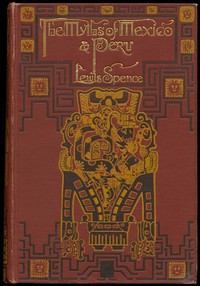
The Myths of Mexico & Peru — A Closer Reading
Edition facts
Lewis Spence opens his preface by noting a 'reawakening' in American archaeology, crediting a scattered band of scholars—French, German, American, and English—whose work he synthesizes. The book itself moves between broad comparative analysis and close description of specific ruins, such as the Palace at Uxmal, where Spence remarks on its 'almost as fresh' condition after three centuries and notes the wooden lintels as evidence of 'comparative lateness.' This attention to material detail grounds the mythological narratives that follow.
A Scholarly Preface as a Map of the Field
Spence's preface does more than thank colleagues; it sketches the intellectual history of Americanist archaeology. He names figures like Brinton, Seler, and Maudslay, and criticizes earlier writers who 'never appeared to consider it essential that the country or the antiquities ... should be examined anew.' The tone is that of a discipline consolidating itself—Spence positions his work as a synthesis of recent excavations and comparative religion, not a travelogue. Readers should note how the preface establishes the book's dual loyalty: to the physical remains (teocallis, huacas) and to the myths that animate them.
Uxmal and the Weight of Stone
Spence's description of Uxmal's 'Casa del Adivino' (the Dwarf's House) is a set piece that blends architecture with legend. He notes the 'exceedingly steep staircase' and the discovery of recently burnt copal as late as 1656—evidence of persistent indigenous practice. The legend of the dwarf, quoted from Stephens, involves a trial of strength: lifting a stone of 'three arobes (75 lb.).' The dwarf's repeated success and the king's escalating demands—'build a palace loftier than any'—mirror the architectural marvel Spence has just described. The myth and the masonry become mutually illuminating.
Voice and Pace: From Catalogue to Narrative
Spence's prose shifts register noticeably between sections. In the preface and architectural descriptions, his sentences are long, packed with names and dates: 'The writers on Central America who lived in the third quarter of the last century relied on the travels of Stephens and Norman.' When he turns to myth, the syntax shortens and becomes more direct: 'The old woman was in raptures. She took it to her heart.' This change in pace signals a shift from scholarly argument to storytelling. The effect is that the myths feel like interludes—briefer, more vivid—within a heavier frame of archaeological report.
Spence's book rewards readers who attend to its structure: the preface is not a formality but a key to his method. The legends are best read alongside the site descriptions that precede or follow them, as Spence often uses architecture to corroborate narrative. Because the excerpts are incomplete, the full arc of his comparative argument remains unclear, but the local texture—the weight of a stone, the freshness of a lintel—is consistently precise.