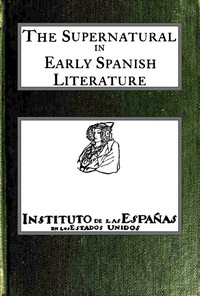
The supernatural in early Spanish literature, studied in the works of the court of Alfonso X, el Sabio — Key Ideas to Explore
Edition facts
Frank Callcott’s 1923 monograph, originally a Columbia University dissertation, systematically catalogs supernatural elements in the works produced under Alfonso X, el Sabio. Drawing primarily from Las Cantigas de Santa María and the Primera Crónica General, Callcott treats the Devil, miracles, divination, and omens as discrete categories, often noting when a motif appears only once or is conspicuously absent. His method is taxonomic rather than interpretive: he collects references, notes their frequency, and occasionally remarks on their literary treatment, but avoids tracing origins or comparing to other European traditions, as he states in the preface. The result is a reference work that privileges completeness over argument, though its dry, enumerative style can make the narrative feel like a checklist.
The Devil as a Diminutive Servant
Callcott’s treatment of the Devil reveals a figure who is less a cosmic antagonist than a functional agent of divine justice. In the Primera Crónica General, devils appear “almost like human beings holding a general conference,” as in the legend of Archbishop Antidio, who overhears an imp boasting of making the Pope sin. The archbishop then demands the devil carry him to the Vatican on his back—a request the imp fulfills. Callcott notes that the Devil often acts as “a sort of scavenger whose business it is to do the disagreeable work,” killing a Vandal king who tries to plunder a church or tormenting a Moor until he converts. In Las Cantigas, the Devil kills a Jew for robbing an image of the Virgin (No. 34) and torments an imprisoned Moor (No. 192). Hell itself is “miserably slighted” by Alfonso’s pen; Callcott observes that while references to “el fuego dell inferno” appear, there are “no attempts to describe the familiar place.” This underdevelopment contrasts with the more vivid depictions of demonic activity elsewhere in medieval literature.
Divination and the Roman Inheritance
Callcott devotes an entire chapter to divination, omens, and auguries, arguing that Spain “excelled all other countries of Europe in the Middle Ages” in this practice. He cites Gaston Paris on the inspection of bird flight in the epic of the seven sons of Lara, noting that “the Cid himself ‘vivait à augure.’” The Spanish, Callcott claims, were “essentially a Roman people,” and this fascination with omens was a survival of Roman civilization. Despite legal prohibitions, the laws were “full and explicit,” implying widespread practice. Callcott’s evidence comes primarily from legal codes rather than narrative texts, which limits the literary analysis. He notes that enchantment appears only once in the Primera Crónica General (the story of Simon Magus) and rarely in Las Cantigas, where a clerk threatens to bottle devils (No. 125) or accusations of enchantment occur (No. 8). The motif, he concludes, did not develop until the Books of Chivalry.
A Cataloguer’s Voice and Its Limits
Callcott’s prose is consistently methodical, favoring classification over narrative. He introduces each supernatural category with a general statement, then lists examples with numbered citations. For instance, he writes that “the love of the mysterious found its greatest development in Spain in the study of divination,” then immediately provides a footnote from Gaston Paris. This structure makes the book useful for reference but repetitive as a reading experience. The author’s own voice emerges only in occasional evaluative phrases, such as calling the Devil’s role “disagreeable work” or noting that Hell is “miserably slighted.” These moments are rare; the dominant tone is that of a dissertation committee report. Callcott explicitly limits his scope: he does not trace origins or compare to other literatures, as he states in the preface. Readers seeking a broader cultural analysis will need to look elsewhere, but for a systematic inventory of supernatural motifs in Alfonso’s court, this study remains a focused resource.
Callcott’s study is best approached as a specialized reference: it organizes a large body of material from Alfonso’s court into clear categories, but its descriptive method leaves interpretation to the reader. Those interested in the Devil’s literary functions or the legal context of divination will find the most direct value. The book’s strength is its thoroughness; its weakness is the absence of a unifying argument. For a fuller picture, pair it with primary texts like Las Cantigas or the Primera Crónica General.