
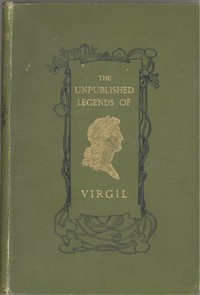
The Unpublished Legends of Virgil — Key Ideas to Explore
Edition facts
In The Unpublished Legends of Virgil, Charles Godfrey Leland presents a collection of Italian folklore where the classical poet appears not as a literary figure but as a benevolent magician. The tales, gathered from oral tradition in the late nineteenth century, often embed detailed magical ceremonies and incantations within the narrative. Leland notes that many of these stories preserve elements of old Etrusco-Roman minor mythology, a layer of belief that was rarely written down but survived among sorcerers and storytellers.
The opening tale exemplifies this blend: a fisherman curses a bandit, turning him and a fish to stone, and only Virgil's intervention—through a silver box of salt and a rhyming incantation—can break the enchantment. The collection thus offers a unique window into vernacular magic and folk religion, framed by Virgil's genial, humorous wisdom.
Oral Transmission and the Collector's Method
Leland explains that the legends were “nearly all taken down by a fortune-teller or witch among her kind,” a method that shaped their content. The informant, experienced in recording recondite lore, naturally emphasized occult details: magical ceremonies are described, incantations given, and the story often becomes “only a mere frame” for a lesson in sorcery. This approach distinguishes the collection from earlier compilations like Comparetti's Virgilio nel Medio Aevo, which Leland acknowledges as the standard work. He claims that only three or four of his hundred tales share a plot with the old Neapolitan stories, and even those contain “original and very curious additional lore.” The result is a text that feels less like polished literature and more like a transcript of living tradition, with all the repetition, digression, and raw belief that entails.
Virgil as Poet, Magician, and Humorist
Across the excerpts, Virgil is consistently portrayed as a poet as well as a magician, but his defining trait is benevolence. He is “a great sage invariably doing good, while always inspired with humour.” In the stone-fish tale, he appears casually on the road, accepts a hare as a gift, and solves the impossible task with a silver box of salt and a rhyming charm. His magic is practical, almost domestic—a pinch of salt to soften stone—and his incantations are playful couplets. This contrasts with the darker, more sinister sorcery found in some European traditions. Leland emphasizes that Virgil's humour is central: he is genial, never malicious, and his interventions restore order with a smile. The tales thus present a folk-hero who is approachable, witty, and deeply embedded in the everyday concerns of peasants and lovers.
The Texture of the Fantastic: Setting and Detail
The opening of the stone-fish story establishes a world where “the blue bluer, the red redder, when the grains of maize were as big as grapes, and grapes as big as pomegranates.” This hyperbolic, fairy-tale register immediately signals a departure from historical reality. Yet the narrative also grounds itself in specific geography—Via Reggio, the Arno—and social hierarchy: a bandit signore, a poor fisherman, a beautiful daughter, a rejected suitor. The curse is delivered in a mix of Italian and English verse, and the resolution hinges on a precise ritual: sprinkling salt and reciting the correct words. This combination of the mundane and the miraculous, the local and the legendary, gives the tales their distinctive texture. Leland's own voice intrudes occasionally, noting parallels with Ovid or citing medieval sources, but the core stories retain the rhythm of oral performance, with direct speech and repeated formulas.
Readers approaching this collection should expect a work that is as much about folk belief as about Virgil. The legends are not polished literary fictions but records of living tradition, complete with repetitions, digressions, and a strong emphasis on magical practice. Leland's editorial presence is light, but his preface provides essential context for understanding the tales' origins and significance. For those interested in the intersection of classical reception, folklore, and vernacular religion, this volume offers a rare and vivid glimpse into a world where poetry and sorcery were never far apart.