
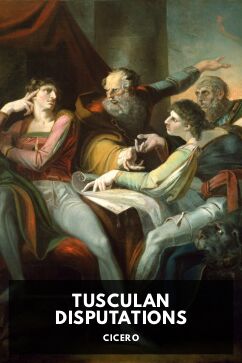
Tusculan Disputations - Cicero
Forget everything you think you know about ancient philosophy being stuffy or remote. Cicero's 'Tusculan Disputations' is something else entirely. Picture this: it's 45 BC. Rome is tearing itself apart in civil war. Cicero, one of its greatest orators and statesmen, has been politically sidelined and is grieving the death of his beloved daughter. Retreating to his villa in Tusculum, he does what many of us do in a crisis—he turns to conversation for solace. But his conversations are with a student, and they tackle the heavy hitters of human existence across five intense sessions.
The Story
There isn't a plot in the novel sense. The 'story' is the progression of these five dialogues, each focused on a single, massive question that keeps us up at night. On day one, they argue that death is nothing to fear. Day two tackles pain and how to endure it. The third conversation asks if a wise person can ever truly suffer from distress. The fourth explores other troubling emotions, and the fifth makes the bold claim that virtue alone is enough for a happy life. Cicero doesn't just state his case; he acts as a guide, walking his friend (and us) through the arguments of famous Greek thinkers, dissecting their ideas, and building a practical Roman philosophy for resilience.
Why You Should Read It
What makes this book special is the voice. Cicero isn't a detached professor. You can hear his own anxiety and hope in every line. He's working this out for himself, in real time. When he argues that grief shouldn't master us, you feel he's giving himself a pep talk. His approach is wonderfully accessible—he uses everyday examples, quotes poetry, and tells stories. He's trying to build a toolkit for the soul, and the urgency is palpable. You're not just learning about Stoic or Epicurean ideas; you're watching a brilliant, wounded man use them as a lifeline.
Final Verdict
This book is perfect for anyone feeling overwhelmed by modern chaos, fans of history who want to see the human side of Rome's great figures, or readers who enjoyed Marcus Aurelius's 'Meditations' but want something with more dialogue and argument. It's not always an easy read—some arguments are dense—but it's a profoundly rewarding one. You'll come away feeling like you've had a deep, comforting talk with a very smart friend who's been through it all. In the end, 'Tusculan Disputations' is less about ancient Rome and more about the timeless struggle to find peace within yourself, no matter what's happening outside.
This digital edition is based on a public domain text. Feel free to use it for personal or commercial purposes.
Margaret Lopez
2 months agoIf you're tired of surface-level information, the wealth of information provided exceeds the average market standard. The insights gained here are worth every minute of reading.
Linda Lee
10 months agoMy first impression was quite positive because the quality of the diagrams and illustrations (if applicable) is top-notch. I'll be citing this in my upcoming project.
Christopher Brown
2 months agoI was particularly interested in the case studies mentioned here, the way it handles controversial points with balance is quite professional. It definitely lives up to the reputation of the publisher.
William White
5 months agoBefore I started my latest project, I read this and the critical analysis of current industry standards is very timely. The price-to-value ratio here is simply unbeatable.






Karen Jones
1 year agoThis is now a staple reference in my professional collection.