
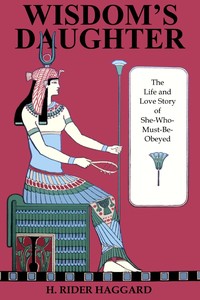
Wisdom's Daughter: The Life and Love Story of She-Who-Must-be-Obeyed — Text and Context
Edition facts
H. Rider Haggard's Wisdom's Daughter presents itself as a manuscript discovered among the effects of L. Horace Holly, the narrator of She. The editor's note argues that Ayesha's defining flaw was vanity, not love: it was vanity that led her to enter the Fire of Immortality, and vanity that stained her hands with the blood of Kallikrates. The excerpts, however, show Ayesha in a different light: as a prophetess in ancient Egypt, observing the love affair between the Greek Kallikrates and the Egyptian princess Amenartas. The narrative voice is that of Ayesha herself, recounting her past with a mixture of detachment and emotion.
The Editor's Framing vs. Ayesha's Voice
The editor's note presents a clear thesis: Ayesha's vanity caused her downfall. It claims she believed her mother died from looking upon her, fearing to bear a less fair child. The note asserts that vanity, not love, led her to kill Kallikrates and to disobey the Prophet Noot by entering the Fire of Immortality. Yet the excerpts from Ayesha's own narrative complicate this picture. She describes herself as a prophetess who speaks under the veil of Isis, claiming 'In Isis I have no self.' Her observations of Kallikrates and Amenartas are sympathetic: she notes Kallikrates's troubled face and his tears, and she longs to comfort him. The editor's moralizing judgment contrasts with Ayesha's own voice, which is introspective and even tender.
Ancient Egypt as a Stage for Passion
The excerpts are set in a temple of Isis in Egypt, during a time of political upheaval—'Egypt is lost,' Kallikrates says. The setting is richly detailed: a statue of the goddess, a pillared court, a cloister, and a shrine with a sculpture of Thoth weighing hearts. Ayesha observes from the shadows as Kallikrates prays, then meets Amenartas, who is 'gloriously attired' with a golden circlet and the royal uraeus. The encounter is charged with tension: Kallikrates tries to flee, but Amenartas draws him into the cloister. Ayesha's narration is precise about gestures and movements, creating a vivid sense of place and emotion. The historical backdrop—the fall of Egypt to Ochus Artaxerxes—adds a layer of political tragedy to the personal drama.
The Dual Self and the Struggle of the Soul
Kallikrates confesses to Ayesha that he is 'the driven of an evil fate' and that he has 'two selves, the self of my body and the self of my soul.' This confession echoes Ayesha's own duality: she is both the prophetess and the woman who will become She-Who-Must-Be-Obeyed. The excerpts show her wrestling with her role as an observer who cannot intervene. When Kallikrates speaks of his love for Amenartas and the blood on his hands, Ayesha responds with a sigh, acknowledging that such duality exists 'in most that breathe beneath the sun.' The narrative thus sets up a parallel between Ayesha and Kallikrates, both torn between duty and desire. This theme of inner conflict is central to the excerpts, and it suggests that Ayesha's later actions may stem from a similar struggle.
The excerpts from Wisdom's Daughter offer a prequel to the events of She, but they also stand alone as a story of love and fate in ancient Egypt. Readers familiar with Haggard's earlier novels will recognize the framing device of a discovered manuscript and the character of Ayesha, but the narrative voice here is distinct: introspective, detailed, and at odds with the editor's moralizing. The text rewards attention to its historical setting and its exploration of the dual self.