All the Way to Fairyland: Fairy Stories — Text and Context
Edition facts
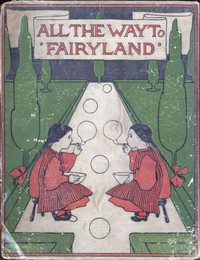
Evelyn Sharp's All the Way to Fairyland opens with an absent-minded magician who has lived in a castle in the air for 777 years and forgotten who he is. The narrator immediately establishes a tone of playful paradox: 'It is not usual, of course, for a magician to be absent-minded; but then, if it were usual it would not have happened in Nonamia.' This self-aware, slightly ironic voice persists throughout the collection, often pausing to comment on the story's own rules or to address the reader directly. The prose moves briskly, with short sentences and quick shifts between dialogue and description, creating a pace that feels conversational rather than stately.
A Narrator Who Interrupts and Explains
Sharp's narrator frequently steps in to clarify or undercut the action. When the magician is astonished by a princess on a cloud, the text notes: 'even an absent-minded magician cannot remain altogether silent.' Such asides give the storytelling a wry, confiding quality. The narrator also explains how the story works: the princess avoids capture by the voices of conversation because she 'reached you without speaking a word.' This metafictional touch—where the plot hinges on a linguistic rule—recurs in later tales. The voice is not omniscient in a distant sense; it is a companion who knows the story's logic and shares it with the reader.
Pace Shifts from Leisurely to Breathless
The collection's pacing varies markedly between scenes. Early passages in 'The Country Called Nonamia' unfold slowly, with long sentences describing the magician's habits and the princess's arrival. But once the characters begin to move—'they set off at once, hand in hand, and walked straight on until they reached the top of the hill'—the prose accelerates. The race down the hill is told in a single, swift paragraph, and the description of the Wonderful Toymaker's valley piles up clauses: 'they lay on the ground in heaps, they were piled high up on the rocks, they hung from the trees.' This rush of detail mimics the children's wonder. Later, when the toymaker spins his tops, the narrative slows again to dwell on the sounds, creating a rhythmic alternation between hurry and stillness.
Recurring Details: Cotton Wool, Tops, and the Rule of Three
Sharp uses small, concrete details to anchor her fantastical world. The princess stuffs 'cotton wool out of her two little pink ears' to block the voices of conversation—a homely object in a magical context. The toymaker's tops are described with precision: one is 'gaily painted' and hums real-world sounds; the other is 'burnished copper' and sings sounds 'that do not exist at all.' The number three appears repeatedly: the magician has lived 777 years; the toymaker blows on the top three times. These recurrences give the stories a structural coherence even as the plots remain whimsical. The narrator also notes that the princess 'remained speechless with astonishment'—a state that the story itself values, since speechlessness saves her from capture.
Readers will find that Sharp's fairy tales reward attention to how they are told as much as what happens. The narrator's interruptions, the shifts in sentence length, and the repeated motifs of sound and silence all contribute to a distinctive voice that is neither sentimental nor moralizing. The stories are best approached as playful experiments in storytelling logic, where the rules are made up as the tale proceeds—and then cheerfully broken.