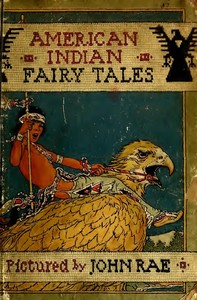
American Indian Fairy Tales — Inside the Classic
Edition facts
W.T. Larned's American Indian Fairy Tales (1921) is explicitly adapted from Henry Schoolcraft's 1839 Algic Researches, a collection of Ojibwe and other Indigenous legends. The catalog subjects classify it under both 'Indians of North America -- Folklore' and 'Fairy tales -- North America,' yet the excerpts reveal a deliberate literary framing that shapes how these stories are presented. The opening chapter introduces Iagoo, the storyteller, who 'knew the secrets of the woods and fields, and understood the language of birds and beasts.' This framing device—a wise elder narrating to children in a winter wigwam—positions the tales as didactic entertainment rather than direct ethnographic record. The text's voice is that of a non-Native author mediating Indigenous oral traditions for a young audience, raising questions about cultural translation and narrative authority.
Framing the Storyteller
The excerpts open with Iagoo, a character who embodies the idealized wise Indian: 'never was anyone so wise and knowing as old Iagoo.' He is described as understanding animal languages and knowing 'the fairy tales and the wonder stories told him by his grandfather.' This framing serves a dual purpose: it authenticates the tales as traditional while also distancing the author from direct responsibility for their content. The narrative voice is consistently that of a third-person observer, not a participant in the culture. Notably, the text specifies that winter is 'the time for story-telling,' when 'the North Wind came howling from his home in the Land of Ice.' This seasonal setting is a common trope in European fairy-tale collections, suggesting a structural borrowing from that tradition. The catalog subject 'Fairy tales -- North America' thus aligns with the book's self-presentation, but the excerpts show that the tales are mediated through a fictional narrator, not presented as direct folklore.
Character and Moral Ambiguity
The story of Grasshopper, a figure who 'had no respect for anybody,' illustrates the book's moral complexity. Grasshopper is a dancer whose 'furious, dizzy dance' creates sand dunes on the shores of Gitche Gumee. He is vain, lazy, and dismissive of the great Manito Man-a-bo-zho, yet the narrative does not explicitly condemn him. Instead, it describes his fine attire—'white deer-skin shirt, edged with ermine' and 'leggings and moccasins ornamented with beads and porcupine quills'—with evident appreciation. This ambiguity contrasts with the catalog subject 'Indians of North America -- Folklore,' which might imply straightforward moral lessons. The text presents Grasshopper as both a trickster and a dandy, a figure who 'cut a fine figure' despite being called a coward. The excerpts do not resolve his fate, leaving readers to infer the consequences of his behavior. This open-endedness is characteristic of the book's approach: it offers vivid characters without didactic closure.
Cultural Specificity and Generic Framing
The catalog subjects group this work under both 'Indians of North America -- Folklore' and 'Fairy tales -- North America,' but the excerpts reveal a tension between cultural specificity and generic fairy-tale conventions. Specific details anchor the stories in a particular geography: 'the Big-Sea-Water, Gitche Gumee,' birch-bark canoes, and porcupine quills. Yet the narrative voice often generalizes, as when it states that 'the Indians gathered in the wigwam' during winter. This phrasing treats Indigenous practices as a unified, timeless custom rather than varying by tribe or era. The book's source, Schoolcraft's Algic Researches, was itself a collection shaped by a non-Native ethnologist. Larned's adaptation further filters these stories through a literary lens, adding descriptive flourishes like 'the sparks leapt up, and Iagoo laid another log on the fire.' Readers should note that the tales are twice-removed from their oral origins, and the 'fairy tale' label may obscure the specific cultural contexts of the original legends.
Readers approaching American Indian Fairy Tales should consider it a literary adaptation rather than a direct transcription of Indigenous folklore. The framing device of Iagoo and the descriptive style reflect early twentieth-century expectations for children's literature. Comparing these versions with contemporary recordings of Ojibwe stories may reveal how Larned's choices—such as emphasizing moral ambiguity or seasonal settings—shape the tales. The book rewards attention to its specific details: the materials of daily life, the names of winds and spirits, and the unresolved fates of characters like Grasshopper. These elements offer a starting point for understanding how one author translated and transformed oral traditions for a new audience.