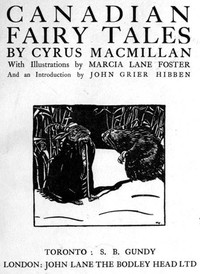
Canadian Fairy Tales — Background and Themes
Edition facts
Cyrus MacMillan's Canadian Fairy Tales (1922) opens with a preface that grounds the collection in specific geography: tales gathered "by river and lake and ocean" from sailors, fishermen, lumbermen, and Indigenous traders. The author's introduction by John Grier Hibben notes the stories retain "the delightful charm and mystery of the Canadian forests," a setting that shapes the diction and action throughout.
The excerpts reveal a consistent narrative voice that blends colloquial dialogue—"Swallow it whole at a mouthful"—with formal framing. Trickster tales dominate, with Rabbit and Fox engaging in a cycle of deception and retaliation. The prose favors concrete sensory details: the prickles of a wild cucumber, the red sky at dusk, the sound of a flute. These choices root the fantastical in a recognizable natural world.
Trickster Dialogue and Deception
The excerpt from the Rabbit and Fox tale showcases dialogue as a tool of cunning. Rabbit's instructions to Fox—"Swallow it whole at a mouthful"—are deceptively simple, leading Fox to choke on a prickly cucumber. The speech is direct, almost instructional, yet carries a mocking undertone. Later, Rabbit invents a wedding party to distract Fox: "The Chief's daughter has just been married to a great warrior." This improvised fiction exploits Fox's greed, a trait the narrator emphasizes with the phrase "he was a very greedy fellow." The dialogue never becomes elaborate; it mimics the practical, survival-oriented talk of hunters. MacMillan's rendering of these exchanges preserves the oral rhythm—short sentences, repeated prompts, and a reliance on action over introspection. The result is a voice that feels both ancient and immediate, where every word serves the plot.
Descriptive Economy in Setting
MacMillan's descriptions are spare but evocative. The Rabbit tale opens with "the moon shone dimly through the trees" and later "the sky was red in the west and the wind was very still." These details do more than set a scene; they create conditions for the action—the dim light hides the cucumber's prickles, the stillness allows Rabbit to hear Fox's approach. The fire that Fox jumps through is described in physical terms: "his eyelids were singed, and his sleek black coat with its silver spots was scorched to a red-brown colour." This transformation is presented as an observable fact, not a moral judgment. The preface's mention of "remote country places where women spin" suggests a similar restraint: the landscape is functional, not ornamental. MacMillan trusts the reader to infer mood from concrete phenomena—a red sky, a crackling fire—rather than from abstract adjectives.
Narrative Structure and Repetition
The Rabbit and Fox tale follows a pattern: Rabbit tricks Fox, Fox vows revenge, Rabbit escapes through another trick. This cycle repeats three times in the excerpt, each iteration escalating the stakes—from a cucumber to a fire. The narrator marks each stage with formulaic transitions: "Fox knew that he had been tricked again" and "he resolved to leave him alone." This repetition mirrors oral storytelling conventions, where listeners expect familiar beats. MacMillan preserves this structure without embellishment, allowing the pattern to generate suspense. The final line—"to the present day the descendants of this Fox have red eyes and a red-brown coat"—provides an etiological close, a common feature in folk tales. The structure is not innovative but faithful to source material, emphasizing recurrence over novelty.
Voice of the Collector
MacMillan's authorial presence is felt through the preface and the framing of tales. He describes his fieldwork with matter-of-fact precision: "gathered in various parts of Canada—by river and lake and ocean." The dedication to his father, a "descendant of Canadian pioneers who upheld the old traditions and used the ancient speech," signals a personal investment in preserving a vanishing oral culture. Yet in the tales themselves, the narrator remains unobtrusive, rarely interjecting commentary. The exception is the occasional moralizing aside, such as "for he was a very greedy fellow." These judgments are mild and consistent with folk-tale tradition. MacMillan's role is that of a mediator: he selects, translates, and arranges, but does not rewrite. The result is a collection that feels collected rather than composed, with the collector's voice audible only at the edges.
Readers attentive to diction will notice how MacMillan balances Indigenous oral patterns with early twentieth-century English prose. The tales reward a slow reading that savors the rhythm of dialogue and the precision of physical description. Because the excerpts are incomplete, the full range of characters and settings remains unknown, but the consistent voice suggests a unified approach to storytelling. Approach the collection as a document of cultural transmission, not a work of original fiction.