Dick and his cat — Edition Insights
Edition facts
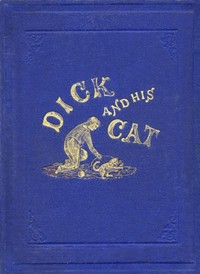
Mary Ellis's 1871 version of the Dick Whittington story imposes a striking linguistic constraint: no word exceeds four letters, and none has more than one syllable. This self-imposed limitation, announced in the prefatory note, transforms the familiar tale into an experiment in minimal vocabulary. The opening scene—a boy sobbing on a doorstep—gains a stark, almost biblical cadence: 'He was too weak to run more. He had had no food all the day.' The short, clipped sentences mirror the boy's exhaustion and hunger, while the restricted lexicon forces Ellis to choose each word with care. The result is a narrative that feels both simple and deliberate, where every phrase carries weight.
A Vocabulary of Four Letters
This linguistic restriction also shapes the rhythm of the prose. Sentences are short, often broken into separate lines on the page, mimicking the halting speech of a child. The text reads almost like verse, with each line a single breath. This structure may have been intended to aid beginning readers, as Ellis suggests in her note: 'any child who has the least knowledge of reading will be able to enjoy it for himself.' Yet the constraint also creates a distinctive aesthetic, one that rewards slow, careful reading.
Poverty and Perception
Dick's own account of his past reinforces this theme. He describes his mother's illness and death in simple, poignant terms: 'She laid her hand on my head, and she said, “I pray Thee, O God, take care of my poor boy.”' The prayer is the only direct speech from the mother, and it encapsulates the story's concern with care and abandonment. The excerpt does not reveal how Dick acquires his cat or what follows, but the pattern is clear: the story repeatedly tests characters' willingness to see beyond surface appearances.
The Rhythm of Repetition
This repetitive style may be a byproduct of the vocabulary constraint, but it also serves a narrative purpose. It gives the story a folk-tale quality, as if each detail must be stated and restated to be believed. The rhythm of the prose—short lines, repeated words, simple syntax—mirrors the oral tradition from which the Whittington legend springs. Whether intentional or not, Ellis's version feels less like a literary retelling and more like a tale told aloud, one phrase at a time.
Readers approaching Dick and His Cat should attend to how the vocabulary constraint shapes not just the language but the story's emotional register. The short, simple sentences can feel abrupt, but they also grant the narrative a peculiar intensity. Notice how Ellis handles moments of high emotion—grief, hunger, kindness—within her self-imposed limits. The result is a version of Whittington that is both a reading exercise and a genuine work of compression, where every word must earn its place.