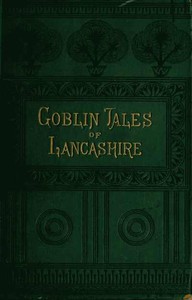
Goblin Tales of Lancashire — Background and Themes
Edition facts
James Bowker's Goblin Tales of Lancashire opens with an introduction that traces local superstitions to Celtic and Scandinavian roots, naming the 'Gabriel Ratchets' as hell-hounds and 'Jinny Greenteeth' as a water-nymph. The tales themselves, however, quickly depart from scholarly framing into a world where fairies steal corn and resent being thanked, and where a woman who uses fairy ointment on her own eye is struck blind. Bowker's diction shifts between antiquated verse—as in 'Satan's Supper,' with its stanzas on 'ye delicacies of ye season'—and a plain, reportorial prose that treats the supernatural as a matter of fact. The result is a collection that feels less like folklore preserved in amber and more like a neighbor recounting odd occurrences with a wry shrug.
Dialect and Diction: The Voice of the Narrator
Bowker's prose is notably plain, avoiding the ornate Gothic style common to Victorian supernatural fiction. When a fairy is caught stealing corn, the narrator remarks that the woman 'regardless of etiquette' thanked him—a dry, almost comic understatement. The verse sections, by contrast, employ a mock-archaic register: 'Ye Evil One giveth unto them a stayve' and 'Ye hagges crowde to ye levee.' This juxtaposition creates a tonal split between the straightforward accounts of rural encounters and the deliberately old-fashioned, almost parodic poems. The effect is to ground the supernatural in everyday Lancashire life while simultaneously signaling the tales' folkloric pedigree.
Fairy Etiquette and Moral Boundaries
A recurring pattern in the excerpts is the strict code governing human-fairy interaction. The woman who thanks the corn-stealing fairy is punished not for witnessing theft, but for breaking the rule of silence: she speaks to a fairy who has not acknowledged her. When asked if she used the ointment 'intended for her child,' she admits to doing so, and is struck blind in one eye. Her daughter, wiser, 'refrained from speaking to them' even when observing them in daylight. These episodes suggest a world where supernatural beings enforce their own laws—laws that often punish curiosity or gratitude, virtues in human society, as trespasses. Bowker presents these encounters without moralizing, letting the consequences speak for themselves.
The Devil's Supper: Verse as Folk Satire
The poem 'Satan's Supper' stands out for its grotesque humor and formal structure. Divided into sixteen numbered stanzas with Latin-like headings ('Ye power of Musicke,' 'Ye delicacies of ye season'), it describes a witches' sabbath where Satan fiddles, imps dance, and the menu includes 'the flesh of infants from the breast, / The toes from dead men's feet.' The tone is deliberately exaggerated, culminating in a rejected imp who steals a jar of stew at cockcrow. The final stanza has Satan complaining, 'Those omelettes were nicely fried; / I have not had enough!'—a bathetic close that undercuts any genuine horror. Bowker uses the verse form to distance the reader from the material, turning folk terror into a kind of black comedy.
Setting and Atmosphere: Lancashire as Liminal Space
The tales are anchored in specific Lancashire geography: moors, fells, ponds, and blasted oaks. The introduction mentions 'the northern and southern mountains and fells' as sources of giant lore, and the poem places Satan 'beneath a blasted oak' with winds that 'hissed, and shrieked, and moaned.' Yet the prose tales often domesticate the supernatural—fairies appear in broad daylight stealing grain, and the woman's encounter happens in a mundane setting. This tension between the wild, stormy landscape of the verse and the everyday settings of the prose suggests that for Bowker, the supernatural is never far from the ordinary. The 'lonely moors' and 'midnight storm' of the introduction are always present as a backdrop, even when the action takes place in a farmyard.
Readers approaching Goblin Tales of Lancashire should expect neither a unified narrative nor a systematic folklore survey. Bowker's collection rewards attention to its shifts in register—from the deadpan prose of the fairy encounters to the deliberately archaic verse of the devil poems. The tales are best read as discrete episodes, each with its own internal logic, rather than as chapters in a continuous story. Pay particular attention to what the fairies and devils do rather than what they are said to represent; Bowker's interest lies in action and consequence, not in symbolism.