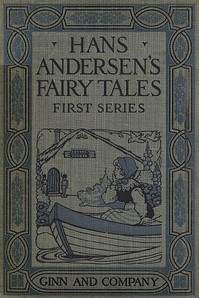
Hans Andersen's Fairy Tales. First Series — Inside the Classic
Edition facts
In Hans Andersen's Fairy Tales, First Series, the stories frequently pivot between the familiar interiors of a child's bedroom or a cottage and the expansive, often magical landscapes beyond. This movement is not merely a backdrop but a structural device that defines the narrative rhythm. The tale of Ole-Luk-Oie, the Sandman, exemplifies this: the action shifts from little Hjalmar's bed to a miniature wedding on a table, then to a debate about travel between a swallow and a hen, and finally to a vision of Chinese figures on an umbrella. Each transition is marked by a change in scale and perspective, drawing the reader into a world where the ordinary and the extraordinary coexist.
The Bedroom as a Stage
Andersen often uses the bedroom as a launching point for his fantasies. In the Ole-Luk-Oie story, Hjalmar's room becomes a theater where the Sandman stages elaborate scenes. The furniture participates in the action: the lead pencil composes a song, and the dolls' house is lit up for a wedding. This domestic setting grounds the fantastical elements, making them feel accessible. The narrator notes that Hjalmar's sister's dolls have had 'a hundred times' of birthdays or weddings, establishing a pattern of repetition that the story then subverts with the 'hundred-and-first wedding.' The bedroom is not just a setting but a frame that contains and amplifies the imaginative leaps.
Scale and Perspective Shifts
Andersen frequently manipulates scale to create wonder. In the excerpt, the narrative zooms from a full-sized child to a cardboard dolls' house with 'lights in all the windows' and tin soldiers presenting arms. The bridal pair sit on the floor, 'leaning against the leg of the table,' emphasizing their miniature size. Later, the umbrella transforms into 'a large china bowl' with blue trees and nodding Chinamen. These shifts in perspective are not merely visual; they alter the reader's relationship to the story, inviting a childlike sense of discovery. The hen's claim to have traveled 'twelve miles in a coop' contrasts with the swallow's vast journeys, further playing with scale and experience.
Recurring Images: Umbrellas, Swallows, and Cabbage
Certain images recur across Andersen's tales, creating a cohesive symbolic language. The umbrella in Ole-Luk-Oie is both a tool for sleep and a canvas for exotic scenes. Swallows appear as travelers, bringing news of warm countries with 'grapes hang[ing] in large clusters.' The hen, by contrast, champions the familiar red cabbage, arguing that 'one cabbage stalk is exactly like another.' This juxtaposition of the exotic and the mundane is a hallmark of Andersen's style. The hen's insistence on the superiority of home, despite its cold weather, reflects a tension between adventure and comfort that runs through the collection. These images are not merely decorative but carry thematic weight, often embodying opposing viewpoints.
Movement Between Realms
The stories in this first series are structured around journeys—literal or imagined. In the Ole-Luk-Oie tale, the bridal pair's decision to stay in the sand pit rather than travel mirrors a larger pattern: characters often choose the familiar over the unknown. The swallow's description of 'mountains glowing with colors more beautiful than we can think of' is countered by the hen's practical objections. This dialogue between adventure and domesticity is a recurring structural element. Andersen does not resolve the tension; instead, he lets both perspectives stand. The final shift to the umbrella's Chinese scene suggests that the fantastical can be contained within the everyday, a theme that unifies the collection.
Readers approaching this first series will find that Andersen's power lies not in elaborate plots but in the quiet, precise way he moves between worlds. Pay attention to the objects that recur—umbrellas, dolls, birds—and how they carry different meanings in different stories. The editorial choices in this edition, based on a comparison of several translations, aim to preserve the clarity and rhythm of Andersen's prose. Let the stories unfold at their own pace, and note how the simplest details often carry the deepest resonance.