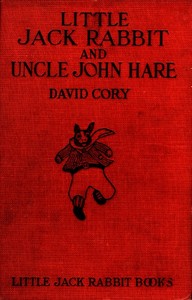
Little Jack Rabbit and Uncle John Hare — A Closer Reading
Edition facts
The story opens with Little Jack Rabbit seeking Uncle John Hare, who has retired to Turnip City to escape the Farmer's Boy and Danny Fox. This setup establishes a pattern: each chapter begins with a journey or an encounter, often triggered by a sign or a chance meeting, and ends with a rhymed promise of the next adventure. The narrative voice frequently addresses the reader directly, using phrases like “Well, you can imagine” and “Wasn't that a wonderful automobile to have?” to create a conversational tone.
The Bunnymobile, a fantastical automobile that “goes so fast you can't count the miles before you are home again,” serves as both a plot device and a recurring image. It enables rapid movement between settings—from the cozy house on Turnip Square to the Shady Forest, Chicken City, and beyond—while also introducing whimsical obstacles, such as the Giant Rabbit who stops his ears at its horn.
Episodic Structure and Rhymed Bridges
The book is built from short, self-contained episodes, each roughly a page or two long. Chapters end with a couplet that teases the next installment, such as “And next time if The Man in the Moon doesn't lose a cent / And so is unable to pay his rent, / I'll tell you another story.” This technique, common in serialized children's literature, gives the narrative a rhythmic, oral quality. The episodes are linked by the characters' travels rather than by a single plot arc; each chapter introduces a new character or location—Dr. Cat, the Big Black Bear, Chicken City—and resolves quickly, often with a polite departure or a sudden interruption. The structure mirrors the logic of a bedtime story, where each segment can stand alone.
The Bunnymobile as a Vehicle of Wonder
The Bunnymobile is more than transportation; it is a source of comedy and conflict. Its horn makes a Giant Rabbit “stop his ears and shut his eyes,” and its noise nearly wakes a bear cub. The vehicle also signals the story's blend of the mundane and the magical: it is kept in a garage, yet it can outrun time itself. When the Black Bear complains that the Bunnymobile “makes a noise / It will wake up my cub with its rub-a-dub-dub,” Uncle John Hare defends it by saying he has “taken the fairies out for a drive.” This detail ties the automobile to the fairy realm, reinforcing the idea that technology and enchantment coexist in this world. The Bunnymobile appears in nearly every chapter, often as the means of arrival or escape.
Movement Between Domestic and Wild Spaces
The story repeatedly shifts between cozy interiors—the white house with green shutters, the log cabin parlor, the front porch on Turnip Square—and untamed settings like the Shady Forest or the meadow. These transitions are abrupt: characters hop from a moving picture theatre to a bear's home, or from a hen's visit to a drive to Chicken City. The domestic spaces are marked by hospitality and routine (Mrs. Daisy Duck as housekeeper, rocking chairs, front porches), while the wild spaces introduce danger or absurdity (the Big Black Bear, the Yellow Dog Tramp). The movement between them is always mediated by the Bunnymobile, which acts as a threshold device. Notably, the characters often tiptoe away from potentially tense situations, preserving the story's gentle tone.
Recurring Motifs: Signs, Songs, and Fairy Logic
Signs appear as plot triggers: the red-lettered sign to Turnip City, the moving picture theatre's announcement, and the toll bridge. Characters often communicate in verse, as when the Yellow Hen sings “Cackle, cackle, what do you think” or the Black Bear chants a lullaby. These songs interrupt the prose and give the story a musical, folkloric quality. Fairy-tale logic governs the world: a Wishing Egg brings new clothes, magic boots appear, and the fairies are trusted advisors (“Always trust the fairies”). Yet the narrative undercuts its own fantasy with mundane details—the bear's cub is put to bed with a lullaby, and the hen wears a pink shawl and purple sunbonnet. This juxtaposition of the ordinary and the marvelous is consistent throughout the excerpts.
Readers may find it useful to approach each chapter as a discrete vignette rather than expecting a continuous plot. The book rewards attention to its rhythmic language and the way it balances domestic comfort with woodland adventure. The Bunnymobile, the signs, and the rhymed chapter endings are the threads that hold these episodes together, creating a world where a rabbit can drive to a moving picture show and then visit a bear without ever losing his polite, cheerful demeanor.