Old French Fairy Tales — Story, Setting & Ideas
Edition facts
The five tales in this collection share a distinctive narrative voice that blends courtly politeness with sharp moral consequences. In the opening of 'Blondine, Bonne-Biche, and Beau-Minon,' the king is described as 'good and all the world loved him; he was just and the wicked feared him'—a formula that establishes clear moral categories from the start. The stories repeatedly place young protagonists in situations where curiosity or disobedience triggers a series of trials, often overseen by a fairy or enchanted creature. The excerpts show that the author, Comtesse de Ségur, uses direct speech and emotional exclamations to heighten drama, as when the little grey mouse declares, 'Come, come, my pretty! Pity it is not here that you will find the temptations.'
Moral Frameworks and Their Limits
The catalog subjects classify this work under 'Fairy tales -- France' and 'Children's stories, French -- Translations into English,' but the excerpts reveal a moral landscape that is more complex than simple didacticism. In 'The Little Grey Mouse,' the father figure explains that Rosalie's curiosity has been exploited by the fairy Detestable, who 'was compelled to leave it, that fatal key.' The language of compulsion and fate suggests that characters operate within a predetermined moral system, yet they still bear responsibility for their choices. The fairy Detestable is not merely a villain but a force that tests the heroine's self-control. The narrative does not simply punish curiosity; it frames it as a flaw that can be redeemed through sustained effort—Rosalie is told she can 'repair your fault by resisting for fifteen days.' This nuance complicates the catalog's simple genre label, indicating that the tales function as moral instruction but also as explorations of agency and redemption.
Recurring Patterns of Temptation and Transformation
Across the excerpts, a clear pattern emerges: a young protagonist faces a temptation (often curiosity or disobedience), suffers a consequence, and then embarks on a journey that may lead to transformation. In 'Blondine,' the princess is 'too young to understand her mother's death' and does not weep, a detail that hints at emotional immaturity that will be tested. In 'The Little Grey Mouse,' Rosalie's curiosity leads to her father's imprisonment and her own forced travel 'all over the world together' with the mouse. The journey motif is literalized in the table of contents, which includes chapters like 'The Journey and Arrival' and 'The Chase.' The tales also feature transformative objects or creatures: a tree of 'marvellous beauty,' a lark and a toad, a wild boar. These elements are not merely decorative; they drive the plot and symbolize the challenges the heroines must overcome. The pattern suggests that the collection is less about static moral lessons than about the process of growth through adversity.
The Role of the Supernatural and the Everyday
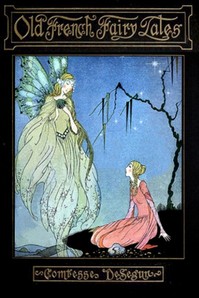
The catalog subjects emphasize 'Fairy tales' and 'Children's stories,' but the excerpts show a curious blend of the supernatural with domestic and agricultural settings. In 'Good Little Henry,' chapter titles include 'The Harvest,' 'The Vintage,' and 'The Fishing,' grounding the fantastical in rural labor. Similarly, 'Ourson' includes a chapter titled 'The Farm—The Castle—The Forge,' juxtaposing different spheres of life. The supernatural beings—fairies, talking animals, enchanted mice—interact directly with human characters, often in domestic spaces. For instance, the little grey mouse emerges from Rosalie's home, and the fairy Detestable disguises herself as a mouse. This integration of the magical into the mundane suggests that the tales are not set in a distant fairyland but in a world where the extraordinary is always adjacent to the ordinary. The illustrations listed in the front matter, such as 'She threw her arms around the neck of Bonne-Biche' and 'Henry sprang upon the Wolf's back,' further emphasize this blend of the familiar and the fantastic.
Readers approaching this collection should attend to the ways each tale structures its moral tests and rewards. The excerpts suggest that Ségur is less interested in simple punishments than in the process of atonement and growth. The recurring motif of a time-limited trial—fifteen days, eight days—creates a narrative tension that propels the stories forward. The illustrations by Virginia Frances Sterrett, listed in the table of contents, offer visual cues to key moments of transformation and confrontation. This edition invites comparison between the tales, as they share structural patterns while varying in setting and character.