On the Tree Top — Reading Notes
Edition facts
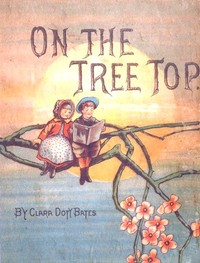
Clara Doty Bates's On the Tree Top (1881) presents thirty fairy tales and nursery rhymes in verse, blending familiar stories with original poems. The collection opens with "The Gold-Spinner," a Rumpelstiltskin-like tale where a miller's boastful claim that his daughter can spin straw into gold sets off a chain of events. Bates's verse employs a conversational, sometimes ironic tone, as when she notes of the miller, "So boastful had he grown, forsooth, / That he cared but little for the truth." The poems vary in length and meter, from the brisk trotting rhythm of "Baby's Trotting Song" to the more elaborate stanzas of "Blue Beard," which stretches over several pages. Illustrations by Jessie Curtis and Frank T. Merrill accompany the text, with color plates for select poems.
Moral Tensions in Verse
Bates's retellings often heighten the moral stakes of the original tales. In "The Gold-Spinner," the king's greed is emphasized: "Yet, as he had greed, he cried, 'Indeed! / I will put her powers to test.'" The miller's boastfulness is punished, but the king's avarice also drives the plot. Similarly, "Blue Beard" dwells on the wife's internal conflict: "a strong desire possessed her / Through it all to get a single peep at that forbidden room." The verse lingers on the consequences of disobedience, with the blood-stained key becoming a symbol of guilt that cannot be erased: "She rubbed it with her handkerchief, she washed in soap and water, / She scoured it with sand and stone, but all was done in vain!" These moments suggest that Bates uses the fairy-tale framework to explore themes of curiosity, trust, and the limits of authority.
Patterns of Repetition and Rhythm
Many poems employ repetitive structures and refrains, echoing the oral tradition of nursery rhymes. "The Three Little Kittens" and "Hickory Dickory Dock" are obvious examples, but even longer narratives like "Blue Beard" use anaphora and parallel phrasing: "Up and down the oaken stairways flitted dainty-footed ladies, / Lighting up the shadowy twilight with the lustre of their bloom." The meter often shifts to match the action—quickening during chases, slowing for descriptive passages. Bates also varies line length within poems; "The Gold-Spinner" alternates between tetrameter and trimeter, creating a sing-song quality that suits the fairy-tale subject. This rhythmic variety suggests the collection was designed for reading aloud, with each poem offering a distinct auditory experience.
Illustration and Text Interplay
The book's illustrations, credited to F. T. Merrill, Jessie Curtis, and others, are integral to the reading experience. The Project Gutenberg edition notes that "some illustrations have been modified to fit this e-text" and that "thumbnail views of all pages are shown at the end of the file." The color plates are listed as "free-standing poems" in the table of contents, indicating that they may have been designed as standalone artworks with accompanying verse. The black-and-white illustrations, often placed in the margins, provide visual cues for key scenes. For instance, in "Blue Beard," the description of the castle—"Whose turrets darkened on the sky, so grand and black and bold"—likely corresponds to an illustration of the forbidding structure. This interplay between text and image reinforces the moral and emotional tone of each tale.
Readers approaching On the Tree Top should note that the collection includes both well-known tales and lesser-known pieces like "Saarchinkold" and "Foolish Bobolink." The poems vary in complexity, with some suited for younger children and others for older readers. The verse format invites comparison with the prose versions of these stories, highlighting how Bates adapts plot and character through rhyme and meter. Pay attention to the illustrations, which often convey details not explicitly stated in the text.