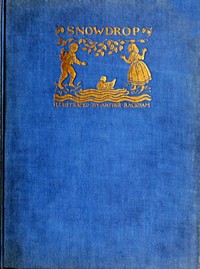
Snowdrop & Other Tales — A Reader’s Guide
Edition facts
The Brothers Grimm's Snowdrop & Other Tales, as presented in this 1920 edition with Arthur Rackham's illustrations, offers a collection where narrative voice oscillates between terse, almost reportorial statements and moments of lyrical repetition. In the excerpt from 'The Goosegirl,' the princess's three drops of blood on cambric serve as a talisman that speaks in verse—'If your mother knew this, it would break her heart'—a device that recurs across the tales. The prose often strips description to essentials, focusing on action and dialogue, as when the waiting-woman commands, 'Dismount yourself, lie down by the water and drink.' This economy of language contrasts with the ornate, full-page color plates that punctuate the text.
Repetition as a Structural Device
The excerpts demonstrate a deliberate use of repetition that shapes both pace and meaning. In 'The Goosegirl,' the princess's thirst and the waiting-woman's refusal are described twice in near-identical terms: 'Get down and fetch me some water in my cup' is met with 'If you are thirsty, dismount yourself.' Each iteration intensifies the power imbalance. The speaking drops of blood repeat their couplet verbatim, creating a refrain that underscores the mother's absent protection. This pattern appears in other tales: in 'Snowdrop,' the mirror's question 'Who is fairest of us all?' recurs, driving the queen's jealousy. The repetition is not merely decorative; it builds tension and signals turning points, as when the princess loses the cambric and the narrative notes she 'had become weak and powerless.'
Voice and Dialogue: Power in Direct Speech
The tales rely heavily on direct speech to convey character and conflict, often with minimal attribution. In the excerpt, the waiting-woman's commands are blunt and dismissive: 'I don't choose to be your servant.' The princess's responses are limited to exclamations—'Alas!'—and the narrator's commentary is sparse. This technique forces the reader to infer emotion from action and repetition. The false bride's request to kill the horse Falada is given in direct speech: 'let the knacker be called to cut off the head of the horse I rode.' The motive—fear that the horse will speak—is implied but not stated, leaving the reader to connect the dots. This economy of voice creates a stark, almost theatrical quality, where dialogue drives the plot more than description.
Pacing Through Accumulation and Sudden Reversal
The narrative pace in the excerpts is characterized by accumulation of small, repeated actions followed by abrupt shifts. The princess's journey unfolds through a series of humiliations—each refusal of water, each command to dismount—that build a rhythm of degradation. The pace quickens with the loss of the cambric, described in a single sentence: 'the piece of cambric with the drops of blood on it fell out of her bosom, and floated away.' The reversal is swift: the waiting-woman seizes power, forces an oath, and swaps horses. The tale then jumps to the castle, where the old King's observation of the 'delicate, pretty little creature' introduces a new tension. This pattern of slow accumulation and sudden reversal recurs in tales like 'Briar Rose,' where the hundred-year sleep is broken by a single kiss, and 'The Wolf and the Seven Kids,' where the mother's return reverses the wolf's triumph.
Readers attentive to narrative voice will notice how the Grimms' prose shifts between the impersonal and the intimate, often within a single tale. The speaking objects—drops of blood, mirrors, animals—serve as moral anchors, but their voices are brief and formulaic. Pay attention to how the pace changes when dialogue is replaced by narration: the latter often compresses time, while the former slows it down. This edition's illustrations by Arthur Rackham offer a visual counterpart to the text's starkness, with detailed, sometimes eerie images that invite comparison with the spare prose.