Stories from The Arabian Nights — A Closer Reading
Edition facts
Laurence Housman's preface to Stories from the Arabian Nights immediately reframes the familiar collection by foregrounding Scheherazade not as a mere narrator but as a figure of dramatic irony. Housman compares her to Penelope, noting that 'procrastination was the basis of her art'—a pointed observation that the tales' value lies less in their individual plots than in the life-or-death context of their telling. This editorial stance shapes the entire volume, which selects six stories and presents them without the frame narrative, yet the preface insists that readers never quite lose 'the sense that it is Scheherazadè who is speaking.'
The Frame as a Lens
Housman's preface argues that the frame tale elevates the stories: 'their prolixity is then the crowning point of their art, their sententious truisms have a flavour of ironic wit, their repetitions become humorous.' This is a specific claim about how the reader's awareness of Scheherazade's predicament transforms the text. The preface acknowledges that the tales are a 'miscellany gathered from various sources' and that even accurate versions are 'full of abridgement, alteration, and suppression.' By eliminating Scheherazade and selecting stories 'mainly with a view to illustration,' Housman admits he has largely done away with the reasons for 'treating tenderly that prolixity which in an impatient age tends to debar readers.' The result is a collection that foregrounds the tales themselves while inviting readers to supply the missing frame.
Movement and Thresholds in 'Prince Firouz Schah'
The excerpt from 'Prince Firouz Schah and the Magic Horse' demonstrates a recurring structural pattern: the protagonist crosses physical thresholds that mark shifts in narrative intensity. The prince's flight on the magic steed involves a precise sequence of actions—turning pegs to control ascent and descent—that mirrors the tale's own careful modulation of pace. As he descends, 'the daylight in which hitherto he had been travelling faded from view,' and he passes 'within a few minutes from sunset into an obscurity so dense.' This rapid transition from light to dark is followed by a movement from rooftop to interior: the prince dismounts on a palace roof, descends a staircase, passes through an open door, and steps over sleeping eunuchs with drawn swords. Each boundary crossed heightens the sense of entering a forbidden space, culminating in the inner chamber where the princess lies. The prince's approach—kneeling and plucking her 'gently by the sleeve'—mirrors the tale's own careful, deliberate revelation of its central encounter.
Recurring Images of Sleep and Awakening
Sleep functions as a repeated motif that structures both the frame and the embedded tales. In the preface, Scheherazade's storytelling is defined by its interruption at dawn, when the king 'renews the call' and she must 'save her neck for the round of another day.' Within 'Prince Firouz Schah,' the prince encounters multiple layers of sleepers: black eunuchs 'lying asleep, each with a drawn sword in his hand,' then 'a number of couches' with 'a fair damsel' asleep on each, and finally the princess herself, who 'opened to him the depths of her lustrous eyes' when awakened. This pattern of sleep and awakening echoes the larger narrative rhythm of the Nights, where each tale ends at dawn and the king's decision to spare Scheherazade hinges on his desire to hear the continuation. The princess's mistaken assumption that the prince is the rejected suitor—'she supposed he could be no other than the suitor whom she knew only by report'—adds a layer of dramatic irony that parallels the reader's own position, knowing only fragments of the larger story.
Illustration and the Visual Imagination
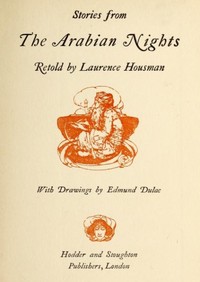
Edmund Dulac's illustrations are integral to this edition, as Housman acknowledges selecting stories 'mainly with a view to illustration.' The preface's focus on the visual—Scheherazade as a 'figure of romance'—suggests that the tales are chosen for their pictorial potential. The excerpt's vivid descriptions of the magic horse's flight, the 'smooth expanse' of the palace roof, and the 'silken hangings' of the inner chamber lend themselves to visual interpretation. Dulac's plates, provided by the National Library of New Zealand, are referenced in the transcriber's note with the instruction that 'in the html file, you can click on the plates to display a larger image.' This digital feature invites readers to engage with the illustrations as a parallel narrative, one that emphasizes the exotic settings and dramatic moments that Housman's prose describes. The interplay between text and image becomes a central experience of this edition.
Readers approaching this edition should keep Housman's preface in mind: the tales are presented without the frame, but the preface insists that Scheherazade's presence lingers. Pay attention to how each story builds suspense through physical movement—ascents, descents, thresholds crossed—and how sleep and awakening punctuate the action. The illustrations by Dulac offer a visual counterpoint; consider how they emphasize certain moments over others. This is not a comprehensive collection but a curated selection, chosen for its illustrative potential and narrative clarity.