The Irish Fairy Book — Background and Themes
Edition facts
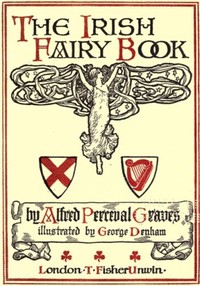
The Irish Fairy Book, edited by Alfred Perceval Graves and illustrated by George Denham, gathers over thirty tales and poems that range from ancient heroic cycles to comic local legends. The excerpts reveal a striking contrast in register: alongside the mythic cadence of W.B. Yeats’s opening poem—sung over Diarmuid and Grania—sit passages of broad dialect comedy, such as the weaver who claims to have killed “three score and tin at one blow” and bluffs his way into the King of Dublin’s service. This editorial note examines how the catalog subjects of “Fairy tales” and “Folklore—Ireland” only partially capture the collection’s actual diversity of tone and narrative strategy.
Heroic Myth and Comic Voice
The excerpts juxtapose two distinct storytelling traditions. Standish James O’Grady’s “The Coming of Finn” and Lady Gregory’s “Cuchulain of Muirthemne” draw on the Ulster Cycle and Fenian lore, treating their protagonists with epic seriousness. In contrast, the anonymous tale excerpted here—likely “The King of the Black Desert” or a similar comic piece—uses a weaver as its hero, a low-status trickster who misleads the King of Dublin with exaggerated boasts. The weaver’s speech is rendered in thick dialect: “I beg God’s pardon and yours for the liberty I tuk; plaze your holiness, I hope you’ll excuse it.” This linguistic playfulness is absent from the heroic sections, which employ a more formal, literary English. The collection thus offers not a single “fairy” mode but a spectrum from reverence to farce.
The Catalog’s Limits: What “Fairy Tales” Misses
The Project Gutenberg catalog assigns this work the subjects “Fairy tales,” “Tales — Ireland,” “Folklore — Ireland,” and “Fairy tales — Ireland.” Yet the excerpts include material that sits uneasily under these labels. The opening poem by Yeats is a lyrical blessing, not a narrative tale. The comic dialogue between the King and the weaver is closer to a humorous anecdote or a märchen than to a fairy tale proper—no fairies appear in the excerpt, only a boastful mortal and a gullible king. Furthermore, the presence of poems by Yeats, Allingham, and Mangan alongside prose narratives suggests the editor Graves conceived the book as a literary anthology, not a folklore collection. Readers expecting only traditional wonder tales will encounter a wider generic range.
Dialect as a Structural Feature
Several excerpts employ heavy Hiberno-English dialect to mark character and social status. The weaver’s speech is peppered with “plaze,” “wanst,” “throth,” and “divarshin,” while the King’s language is only slightly less colloquial. This dialect is not merely decorative; it drives the comedy of misunderstanding. When the King reads the weaver’s shield—“he killed three score and tin at one blow”—he misinterprets a literal boast about flies as a martial feat. The weaver’s pretended deference (“plaze your holiness,” “plaze your riverence”) exploits the King’s vanity. Such verbal play recurs across the collection: in “Daniel O’Rourke” by T. Crofton Croker and “The Legend of Knockgrafton,” dialect shapes narrative tone. The catalog subject “Folklore — Ireland” hints at this, but the excerpts show that dialect is a deliberate literary device, not just a transparent record of speech.
Readers approaching The Irish Fairy Book should expect variety: heroic saga, lyric poetry, and dialect comedy sit side by side. The editor’s preface, not excerpted here, likely frames these as expressions of a single fairy-lore tradition, but the texts themselves resist easy categorization. Pay attention to the narrative voice in each piece—whether formal, lyrical, or colloquial—as it often signals the tale’s cultural register and intended effect.